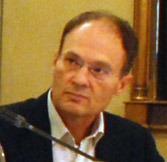
Interview with Dr Andrew Ladley, International constitution building practitioner

خدمة تويتر

Zaid Al-Ali

  • zalali
    zalali #SCAF gives political forces 48 hours to agree on president's mandate or else another constitutional declaration. via @monaeltahawy
  • zalali
    zalali Thus, if a single party comes 2dominate the parliament in the future, it will b able to control the agencies and therefore much of the state
  • zalali
    zalali By leaving agencies out of constitutions, assembly will be surrendering control over them to political parties

مساعدة دولية

إن دور الدعم الدولي والخارجي في الإجراءات القومية لبناء الدستور له تأثير جوهري على تصميم هذه الإجراءات والخيارات المؤسسية التي يتم تضمينها في النهاية في الدساتير.

برنامج تدريبي

إن مورد CONNECT الخاص ببناة الدستور عبارة عن أداة تدريب تفاعلية تؤكد على عملية تبادل الخبرات كوسيلة لبناء قدرات الممارسين لحل بعض المعضلات التي يواجهونها في بناء الدستور.

الدليـل

يستعرض الدليل ويناقش بعض خيارات التصميم الإجرائي والمؤسسي التي وضعها الخبراء في اعتبارهم مؤخرًا أثناء بناء الدساتير المعاصرة.

أوراق بحثية

تُعرض بعض الموضوعات المختارة بشيء من التفصيل وفقاً للحوارات الناشئة والمستمرة بين الممارسين والمتخصصين.

وسائط متعددة

مجموعة من موارد الوسائط المتعددة مستمدة من عمليات بناء الدستور وتتعلق بها.

روابط شبكة الانترنت

توفر روابط شبكة الانترنت قائمة شاملة لكافة المنظمات والشركاء المعنيين العاملين في مجال بناء الدستور والمواضيع المتعلقة به.

مواقع مكمـلة

ونوصي أيضا بهذه المواقع؛
Date: 15 Aug 2011
Dr. Andrew Ladley
Dr. Andrew Ladley

“Comparative experience is always valuable – but I think it is of greatest value where it helps constitution builders learn their own lessons, from their own histories – and to find mechanisms that will work locally.”

Dr Andrew Ladley is the lead contributor to the policy paper Constitution building after conflict: External support to a sovereign process and is an international constitution building practitioner with vast experience in Asia and Africa. He is an Adjunct Professor at Victoria University of Wellington and an international consultant on conflict issues, particularly in the constitutional, justice and electoral fields. In 2008-9 he served as a Senior Expert Mediator on Constitutional Arrangements for the Standby Team of Mediation Experts working with the United Nations and the Norwegian Refugee Council. In that capacity he assisted in a number of issues, including in Kenya, Cyprus, Kosovo and the Southern Philippines. Over the last two decades, he has assisted with various international missions, including in Malaysia, Cambodia, South Africa, Bosnia, Gambia, East Timor, and Jamaica.

Here he responds to questions related to the issues addressed by the policy paper and to recent global events affecting constitutional governance.

1. The policy paper, Constitution building after conflict: External support to a sovereign process, relates the rise in intra-state conflict in the 1990s to the ‘unprecedented bloom’ in constitution building that followed. In the early part of 2011, we witnessed a wave of popular movements across the WANA (West Asia and North Africa) region challenge authoritarian governments, a wave which is still ongoing. What kinds (key features) of constitutional processes are we likely to see emerging in this region?

The ingredients are already on the table – and whilst every situation has its own history, the mix is familiar. Though two dramatic processes of constitutional change (Tunisia, Egypt) do not a ‘bloom’ make, the region appears to be on the brink of something historic. In high school chemistry, I was fascinated by the experiments where we dripped something into a solution of chemicals. Drop after drop, nothing apparently happened. Then suddenly, with one drop, the entire solution dramatically changed colour and character. Looking back at the end of the Cold War, it is now evident that what appeared to be sudden change, actually reflected decades of ‘political drip’. The Arab Spring suggests this political chemistry had also been happening in the WANA region. The commonality has been the apparent sudden loss of popular ‘willingness’ (however mixed between genuine, grudging and coerced) to put up with authoritarian government. In state after state, this unwillingness appears to have been defiant, popular, inter-connected and extraordinarily courageous. As regards the future, much will depend on how bloodily resisted (and prosecuted) were the demands for change. The story is unfolding. Governments and citizens are still contesting. In some areas, particularly, it seems that there will be more blood in the streets before processes of peaceful constitutional change are widely accepted. In response to the demands for change, there are three key processes at play in different degrees in the region: state violence resisting constitutional change, constitutional reforms and constitutional replacement.

With regard to the first category, where there is violent state resistance to constitutional change, the constitutional process will obviously depend on the result of the conflict. In a full-scale internal conflict, there are often tensions between processes (as in Libya, currently). Hence, one option may seek an internationally mediated ‘power sharing’ result with the common ingredients of ceasefire, negotiations, security for key actors (including personal, political, financial and legal) and some sort of political reform. A competing process may be (also internationally-backed) military progress, emergency rule that rejects any role for ‘outgoing leaders’, and envisages a transition to an interim government, an interim constitution and then mechanisms for popular consultation and support for a new constitution (i.e. the third category of constitutional replacement). A major civil war between armed factions can shade into violent state repression, with varying degrees of civil resistance, and varying degrees of reform put on the table (as in Syria, currently).

In the second category, we can expect more peaceful reforms, including for political expression and representation, accountability, the rule of law, and fair electoral processes. These tend to be made by current parliaments and processes (as in Jordan, currently).

The third category (as in Tunisia and Egypt, currently) assumes that the old order has broken down and the political facts on the ground have changed sufficiently to demand a new constitution. Here again, we can already see the full suite of possibilities at play, including interim government, interim constitutions, strong demands for representation and consultation on new processes involving civil society, political actors, and ‘key sectors’ (regions, tribes, sometimes the military), heading to combinations of draft constitutions, constituent assemblies, and formal referenda.

All these process will require some consultation to change the constitutional mechanisms regulating competition for, and the exercise of, state power (elections, politics, free-er expression, independence of electoral and judicial machinery, the rule of law). As with the end of the 20th century bloom, these changes will be imperfect and it will take time for the transitions to consolidate. Despite the assertions of some, there is little evidence of ‘foreign ideologies’ or of popular yearning for the restoration of conservative religious orders – indeed, just the contrary. The key to future stability in governments and in the region, will surely lie in how closely the processes for constitutional changes reflect the political chemistry that demanded them.

2. Do you think sharing international experience can benefit countries in the WANA region that undertake constitution building processes?

Comparative experience is always valuable – but I think it is of greatest value where it helps constitution builders learn their own lessons, from their own histories – and to find mechanisms that will work locally. Put simply, the more widely-learned the lessons, the more durable the constitutional results. For example, it may be useful to borrow from international experience a rule that judges should be independent. But it is much more valuable to use comparative experience to work with local constitutional builders to show why judicial independence has been important, so that local constitution builders can form their own analysis of how the absence of judicial independence has shaped their own constitutional order. Further, there are examples of how practically to bring about an independent judiciary, in a place where current reality is of corrupt and/or politically biased judges. In Bosnia, for example, the attempt to ‘monitor and train’ judges by the UN and then the EU, has been massively expensive – and of contested success. There are real lessons there that can be of great value.

Another example might be the importance of a politically neutral and citizen-trusted police force. The experience of Northern Ireland could be used in discussions and processes, linking with domestic examples and histories, leading to a wider constituency for new constitutional rules supporting the rule of law generally, and police reform particularly.

3. What lessons has the international community learned from the experiences of supporting constitutional processes in the 1990s and early 2000s that should be kept in mind?

For the organizations, aid agencies and international bodies that have been engaged with support for constitutional processes over the last 20 years or so, I am sure there are lessons relating to managing competition, overlapping support, coordination and local ownership. Also, there is more acknowledgement of the importance of supporting longer-term processes rather than ‘quick-fixing’. A ‘fragile state’ is by definition probably not able to implement the massive institutional reform demanded by new constitutions, pressed into place by donors. This lack of capacity sets up states for failure in relation to constitutionalism and the rule of law generally. Of course, constitutions should be ‘aspirational’, but they should also be realistic. My view is that both hosts and supporters are increasingly adapting their approaches around the simple point that enactment of a constitution is just one interesting step in a long constitution building story.

4. Have any trends emerged in countries that underwent constitution building in the last 5 to 20 years as they seek to consolidate and entrench constitutional governance?

A really important indicator so far is that there has essentially been no repudiation of the underlying democratic basis for the post-Cold War reforms. There have been political crises, of course, some of which have become constitutional. The examples of the Madagascar coup and failures to abide by the results of elections in Kenya, Zimbabwe and Ivory Coast, point at weaknesses in the implementation of democratic constitutionalism. But we are not (at least yet) seeing any alternative constitutional models being put forward. As regards consolidation of constitutional governance, my view is that the new Kenyan constitutional provisions for open applications for Supreme Court judges might be the start of a new trend towards tackling corrupt, partisan or otherwise inadequate judicial systems and processes.

5. One of the aims of the policy paper is to define constitution building as a specialized field, albeit one that is cross-cutting and multidisciplinary in nature. What can be done by those in the practitioner community to contribute to this effort?

Drafting itself is a specialized skill, but for the field as a whole a multidisciplinary approach is important. For the practitioner community, the challenges include the reality that much of the practical engagement in constitutional building is affected by competitive, overlapping and sometimes contradictory roles played by different people or organizations – not only on the international side! If these are not handled well, the problems can be exacerbated rather than eased by multidisciplinary approaches.

13 July 2011

التعليقات

علِّق

محتويات هذا الحقل سرية ولن تظهر للآخرين.
  • وسوم إتش.تي.إم.إل المسموح بها: <a> <em> <i> <strong> <b> <cite> <code> <ul> <ol> <li> <dl> <dt> <dd> <h2> <h3> <h4> <h5> <p> <span> <hr>
  • You may insert videos with [video:URL]
  • You may use [inline] tags to display contents inline.
  • The Sprawk translator will translate this text based on the site's translation settings.
  • تتحول مسارات مواقع وب و عناوين البريد الإلكتروني إلى روابط آليا.
  • Glossary terms will be automatically marked with links to their descriptions. If there are certain phrases or sections of text that should be excluded from glossary marking and linking, use the special markup, [no-glossary] ... [/no-glossary]. Additionally, these HTML elements will not be scanned: a, abbr, acronym, code, pre.

معلومات أكثر عن خيارات التنسيق

CAPTCHA
This question is for testing whether you are a human visitor and to prevent automated spam submissions.
4 + 14 =
Solve this simple math problem and enter the result. E.g. for 1+3, enter 4.

مداخلات مشابهة