

Kuwait is a constitutional monarchy and has the oldest directly elected parliament among the Arab states of the Persian Gulf. The head of state is the Emir or Sheikh, a hereditary office. A council of ministers, also known as cabinet ministers, aids the Prime Minister in his task as the head ofGovernment of Kuwait which must contain at least one elected member of the Kuwaiti parliament, known as Majlis Al-Umma (National Assembly). The National Assembly has the power to dismiss the Prime Minister or any member of cabinet through a series of constitutional procedures. All cabinet ministers are answerable to the National Assembly.
The National Assembly consists of fifty elected members, who are chosen in elections held every four years. Government ministers are also granted membership in the parliament and can number up to sixteen excluding the fifty elected members. According to the Constitution of Kuwait, nomination of a new Emir or Crown Prince by the ruling Al-Sabah family has to be approved by the National Assembly. If the nominee does not win the votes of the majority of the assembly, the royal family must submit the names of three other candidates to the National Assembly, and the Assembly must approve one of them to hold the post. Any amendment to the constitution can be proposed by the Emir but it needs to be approved by more than two-thirds of the members of the National Assembly before being implemented.
There have been several conflicts between the Emir, the government and the National Assembly over various policies. The National Assembly was suspended from 1976 to 1981, from 1986 to 1991 and from May 1999 to July 1999 due to irresolvable conflicts between some members of the government and the Assembly. The Assembly was dissolved again in May 2009 by the Emir leading to the resignation of Prime Minister Sheik Nasser Mohammad al-Ahmad al-Sabah and the rest of the Cabinet. Nationwide elections were held on May 16 2009.
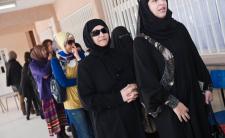
More than two-thirds of those who reside in Kuwait do not hold Kuwaiti citizenship and thus cannot vote in parliamentary elections. Additionally, prior to 2005, only 15% of the Kuwaiti citizen population was allowed to vote, with all "recently naturalized" citizens (i.e. those of less than thirty years' citizenship), and members of the Kuwaiti Armed Forces excluded. On 16 May 2005, Parliament permitted women's suffrage by a 35-23 vote, subject to official interpretation of Islamic law and effective for the 2006 parliamentary election.
The decision raised Kuwait's eligible voter population from 139,000 to about 339,000. In 2006, Kuwaiti citizens were estimated to be more than 960,000. In 2005, the former Prime Minister Sheikh Sabah al-Ahmad al-Sabah announced the appointment of the first women as a cabinet minister, Massouma Mubarak. She was designated the post of Planning Minister and Minister of State for Administrative Development Affairs. During the 2008 parliamentary elections, 27 of the 275 candidates were women. However, none of them won. In the parliamentary elections on 16 May 2009, 16 female candidates contested for 50 seats for a four-year term. Four female candidates won their seats and became Kuwait's first female lawmakers.

| Branch | Hierarchy | Powers | Removal |
|---|
Share this article